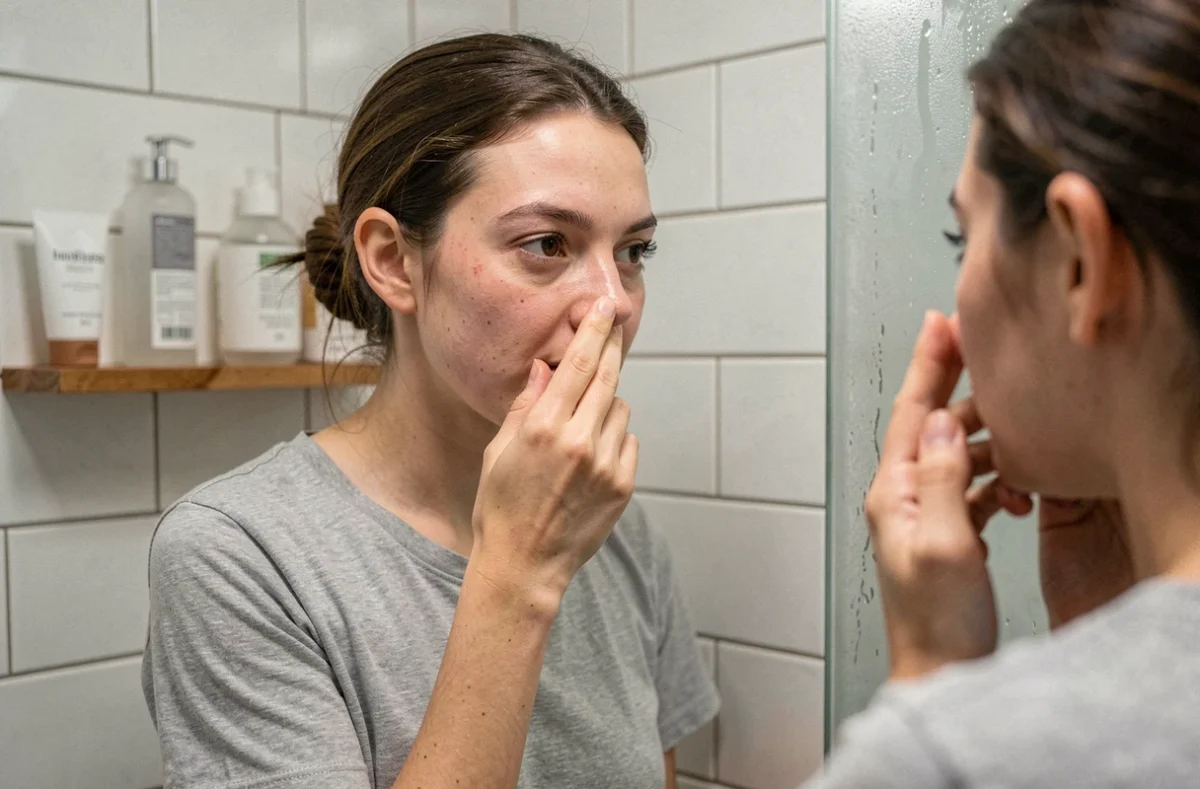
A nose piercing that is migrating toward the surface does not always mean it will ultimately be rejected. Distinguishing between migration, jewelry-related irritation and true rejection determines what to do next: removal, waiting, consultation and possible repiercing. Confusing these situations can lead either to removing a piercing that could have been saved or to repiercing too soon through weakened tissue.
Diagnostic guide: migration, irritation, rejection or infection in a nose piercing
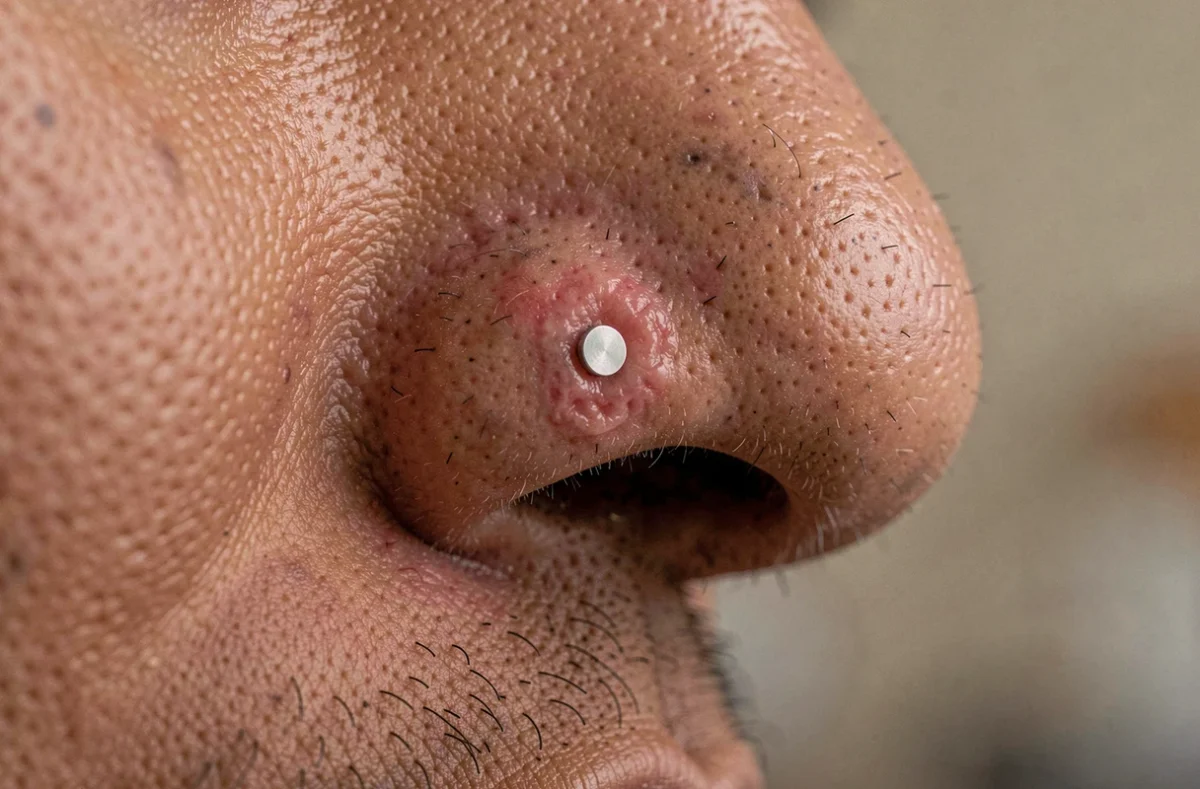
Gradual thinning of the tissue between the two openings of the piercing channel, together with a bar that is becoming increasingly visible beneath the skin, points to the piercing migrating toward the surface. The jewelry shifts without pronounced signs of inflammation. Localized redness, tenderness to the touch or a persistent crust, without any change to the piercing channel, is more likely to indicate mechanical irritation or a reaction to the material.
True rejection involves both migration and a tissue reaction: the body expels the jewelry as a foreign object. The skin thins, the channel shortens, and the jewelry eventually comes out if nothing is done.
An infection is clearly different. Redness spreading beyond the immediate area, thick, foul-smelling discharge, red streaks, significant swelling or a fever warrant medical evaluation, not a visit to the piercer. In France, official guidance recommends seeing a doctor if the infection persists, spreads or is accompanied by a fever.
Understanding nose piercing rejection starts with making this clinical distinction, because the appropriate course of action differs significantly depending on the diagnosis.
- Migration without inflammation: a qualified piercer can assess whether changing the jewelry (material, gauge or length) is enough to stabilize the channel.
- Mechanical irritation: check the jewelry alloy, pressure from a mask or glasses, and the aftercare routine.
- Confirmed rejection with significant thinning: remove the jewelry before the skin breaks on its own to minimize residual scarring.
- Suspected infection: seek medical advice first; do not remove the jewelry without guidance (the channel may close and trap the infection).
Nose piercing healing: why the outside can be misleading
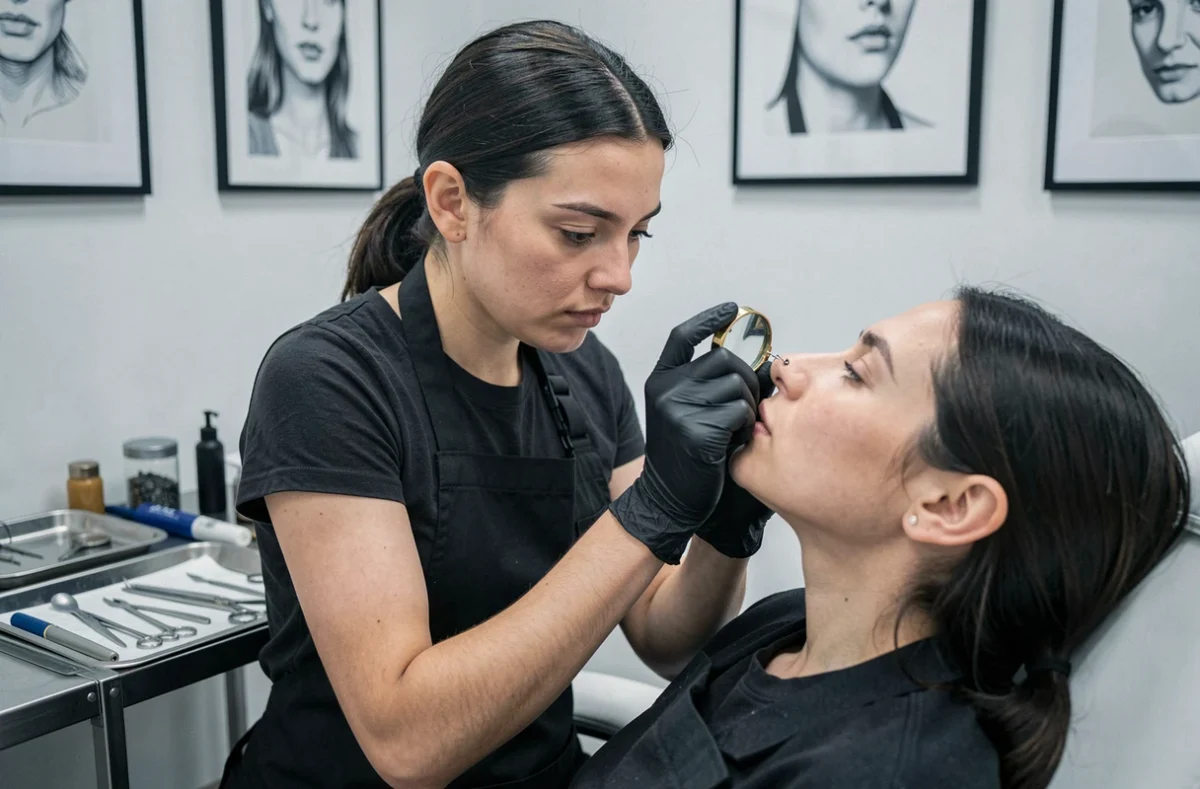
The Association of Professional Piercers notes that the piercing channel heals from the outside in. Nostrils can take six months or longer to heal completely. An opening that looks closed and feels painless on the surface may still be fragile or even open deeper inside.
This affects when repiercing should be considered. Piercing tissue before the inner channel has fully healed can lead to another rejection, abnormal healing or fibrous encapsulation that makes the next piercing unstable.
The texture of the scar matters as much as its age. Hypertrophic scar tissue (a raised, firm, pinkish bump) or a keloid (an overgrowth extending beyond the original wound) does not behave like healthy skin. An experienced piercer will feel the area, assess the remaining thickness of the cartilage or nostril, and determine whether a new channel is viable, possibly a few millimeters away from the original.
How long to wait before repiercing a nose: there is no universal rule
No professional source sets a universal waiting period after rejection. Articles that give precise time frames (three months, six months) oversimplify a situation that depends on several individual factors.
The decision to repierce depends on the condition of the tissue, not the calendar. We recommend a two-step assessment.
Assessment by the piercer
The piercer checks the flexibility of the scar tissue, the thickness of the area and whether a new channel is feasible. If the scar is still firm, pink or tender when pressed, it is too soon. Mature tissue is flexible, close in color to the surrounding skin and painless.
Choosing a new placement
Repiercing in exactly the same spot is not always possible. Scar tissue has a poorer blood supply and is denser than native skin, increasing the risk of another rejection. Even a slight shift into healthy tissue improves the chances of normal healing.
If the anatomy of the nose does not allow the piercing to be moved (a thin nostril or narrow cartilage), the piercer may consider repiercing at that location inadvisable. Accepting this decision can prevent repeated rejection, which progressively damages the tissue.
French regulations for piercing and choosing a professional
In France, anyone performing piercings must be trained in hygiene requirements, register their activity with the ARS (regional health agency), and follow a protocol that includes informing clients in advance about risks, contraindications and aftercare. These requirements are not optional.
For repiercing after rejection, these obligations are especially important. The professional must assess the existing scar, choose an appropriate jewelry material (ASTM F136 titanium or niobium), and recommend a gauge and length suited to the thickness of the remaining tissue.
- Check that the piercer is registered with the ARS in their region.
- Ask which material will be used and what grade it is (implant-grade titanium remains the standard for reactive skin).
- Make sure the professional examines the scar before confirming that the procedure is feasible.
How to prevent a second nose piercing rejection
A previous rejection increases the likelihood of another if the original causes are not identified. Jewelry material is the most common factor: an alloy containing nickel can cause reactions in sensitive skin, even after apparently normal healing.
Piercing depth also matters. A piercing that is too shallow leaves too little tissue to anchor the jewelry. The piercer adjusts the angle and depth to the actual thickness of the nostril, which varies from person to person.
Repeated mechanical stress (blowing your nose forcefully, wearing a tight mask or handling the jewelry) can cause ongoing irritation that may lead to migration. Minimizing contact with the jewelry throughout the healing period remains the simplest and most effective measure.
In most cases, a nose can be repierced after rejection, provided the tissue is allowed to heal completely and the area is assessed by a qualified professional. The deciding factor is not how long it has been since the jewelry was removed, but the actual condition of the tissue when repiercing is being considered.