
Converting 400 ml to centiliters means dividing by 10: the result is 40 cl. The answer can be obtained in one operation, but the real difficulty lies not in the calculation itself. It lies in the measurement, in the choice of instrument, and in reading the liquid level.
This article details what happens when handling volumes in cooking or preparation, beyond the simple mathematical formula.
Meniscus and reading error: what skews measurement in cooking
The conversion between milliliters and centiliters is a fixed operation that depends neither on the ingredient nor on the temperature. According to the BIPM (International Bureau of Weights and Measures), the liter is accepted for use with the International System of Units, with 1 L = 1 dm³. The centiliter is one hundredth of a liter, and the milliliter is one thousandth. The relationship is therefore purely decimal.
The problem arises when pouring and reading. With a liquid in a transparent container, the surface is not flat: it forms a meniscus, a concave curve for water and most aqueous liquids. The correct reading is taken at the bottom of the meniscus, with the eyes positioned exactly at the level of the graduation.
If you want to understand in detail how many centiliters is 400 ml in the context of a recipe, keep in mind that this precision in reading matters more than the formula itself.
Looking at the measuring cup from above or below shifts the reading by several milliliters. On a volume of 400 ml, a few milliliters difference may seem negligible. For a baking recipe that requires a precise ratio between liquid and flour, this discrepancy is enough to alter the final texture.
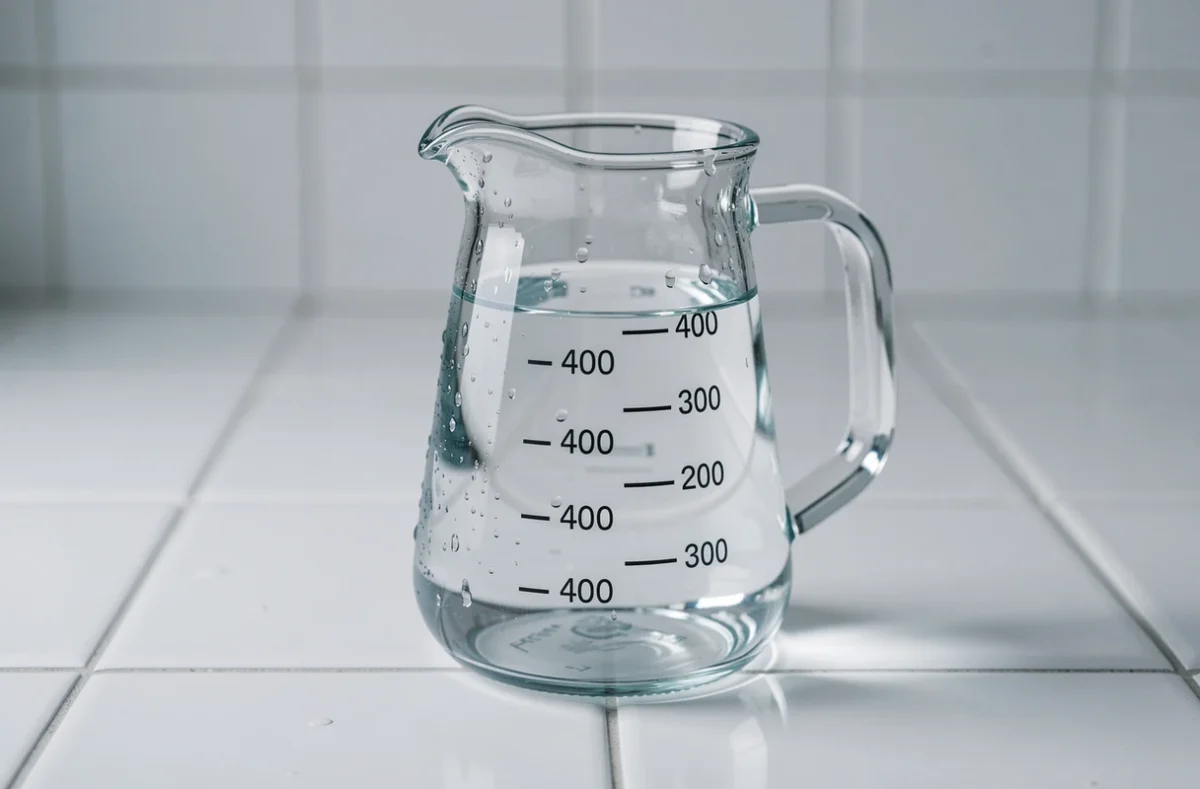
Graduated measuring cup: resolution and reliability of volume measurement
A measuring cup sold in supermarkets usually displays graduations every 25 or 50 ml. Measuring exactly 400 ml with a graduated container marked every 50 ml is straightforward: the graduation aligns perfectly. However, measuring 375 ml with the same cup requires a visual estimation between two marks.
The BIPM, in its International Vocabulary of Metrology (VIM, 3rd edition, 2012), distinguishes the resolution of an instrument (the smallest increment it can display) from the overall measurement uncertainty. In other words, converting 400 ml to 40 cl does not guarantee that the volume poured is actually 400 ml. The conversion is accurate, but the measurement depends on the tool.
Criteria for choosing a suitable container
- Check that the graduations cover the target volume without interpolation (a 500 ml measuring cup is better than a 250 ml cup that would need to be filled twice)
- Prefer a rigid transparent glass or plastic container, where the meniscus is clearly visible
- Ensure that the graduations indicate both ml and cl, which avoids any mental conversion when pouring
Filling a small container twice doubles the measurement uncertainty. A single measuring cup of sufficient capacity mechanically reduces the error.
Conversion table for ml, cl, and liters for common recipe volumes
The formula remains the same regardless of the volume: cl = ml ÷ 10. The table below groups the volumes most commonly encountered in recipes, along with their equivalents in centiliters and liters.
| Milliliters (ml) | Centiliters (cl) | Liters (L) |
|---|---|---|
| 50 ml | 5 cl | 0.05 L |
| 100 ml | 10 cl | 0.1 L |
| 200 ml | 20 cl | 0.2 L |
| 250 ml | 25 cl | 0.25 L |
| 330 ml | 33 cl | 0.33 L |
| 400 ml | 40 cl | 0.4 L |
| 500 ml | 50 cl | 0.5 L |
| 750 ml | 75 cl | 0.75 L |
| 1,000 ml | 100 cl | 1 L |
Commercial containers sometimes use ml (cans, milk cartons) and sometimes cl (wine bottles, craft beers). The physical volume is strictly identical, only the displayed unit changes according to industry conventions.

Volume and mass: the frequent confusion between ml and grams
In cooking, many recipes mix volume units (ml, cl) and mass units (grams). For pure water, the correspondence is nearly perfect: 400 ml of water weighs about 400 g. This practical equivalence does not apply to other liquids.
Oil, honey, heavy cream, or whole milk have different densities than water. 400 ml of honey weighs significantly more than 400 ml of water, because honey is denser. Therefore, converting milliliters to grams requires knowing the density of the liquid in question, while converting milliliters to centiliters does not depend on any external parameter.
Some density references in cooking
- Water: density close to 1, so 400 ml ≈ 400 g
- Whole milk: density slightly above 1, so 400 ml weighs a bit more than 400 g
- Vegetable oil: density below 1, so 400 ml weighs less than 400 g
- Liquid honey: density significantly above 1, so 400 ml weighs well over 400 g
When a recipe indicates a volume in milliliters, the conversion to centiliters is immediate (divide by 10). When it indicates a mass in grams, a scale is needed, not a measuring cup.
Why French recipes alternate between ml and cl
French cookbooks predominantly use centiliters for liquids (20 cl of cream, 15 cl of milk). Industrial packaging, on the other hand, often displays milliliters, in accordance with European labeling standards. This dual convention requires regular conversion.
The decimal metric system makes it simple: moving the decimal point one place is enough. 400 ml becomes 40.0 cl. 75 cl becomes 750 ml. No complex conversion tables, no factors to memorize.
The real difficulty is never the calculation. It lies in the action: reading the meniscus at the correct level, using a container whose resolution matches the target volume, and not confusing volume and mass when the recipe switches from a tablespoon to a measuring cup.